+86-13566758039


As consumers become increasingly attentive to the materials used in their drinkware and the overall user experience, pure titanium cups have gained significant market attention. Titanium is valued for its lightweight nature, strong corrosion resistance, and chemical stability—qualities that have led to its widespread use in aerospace, medical devices, outdoor gear, and high-end dining ware.
However, as the market for titanium cups has expanded, a diverse array of products has emerged, including pure titanium cups, titanium alloy cups, cups with titanium liners, and titanium-coated cups. While these items may look similar, they differ substantially in terms of actual material composition, structural design, and production costs.
So, how can consumers distinguish a genuine pure titanium cup from the rest? Here are several key factors to consider.
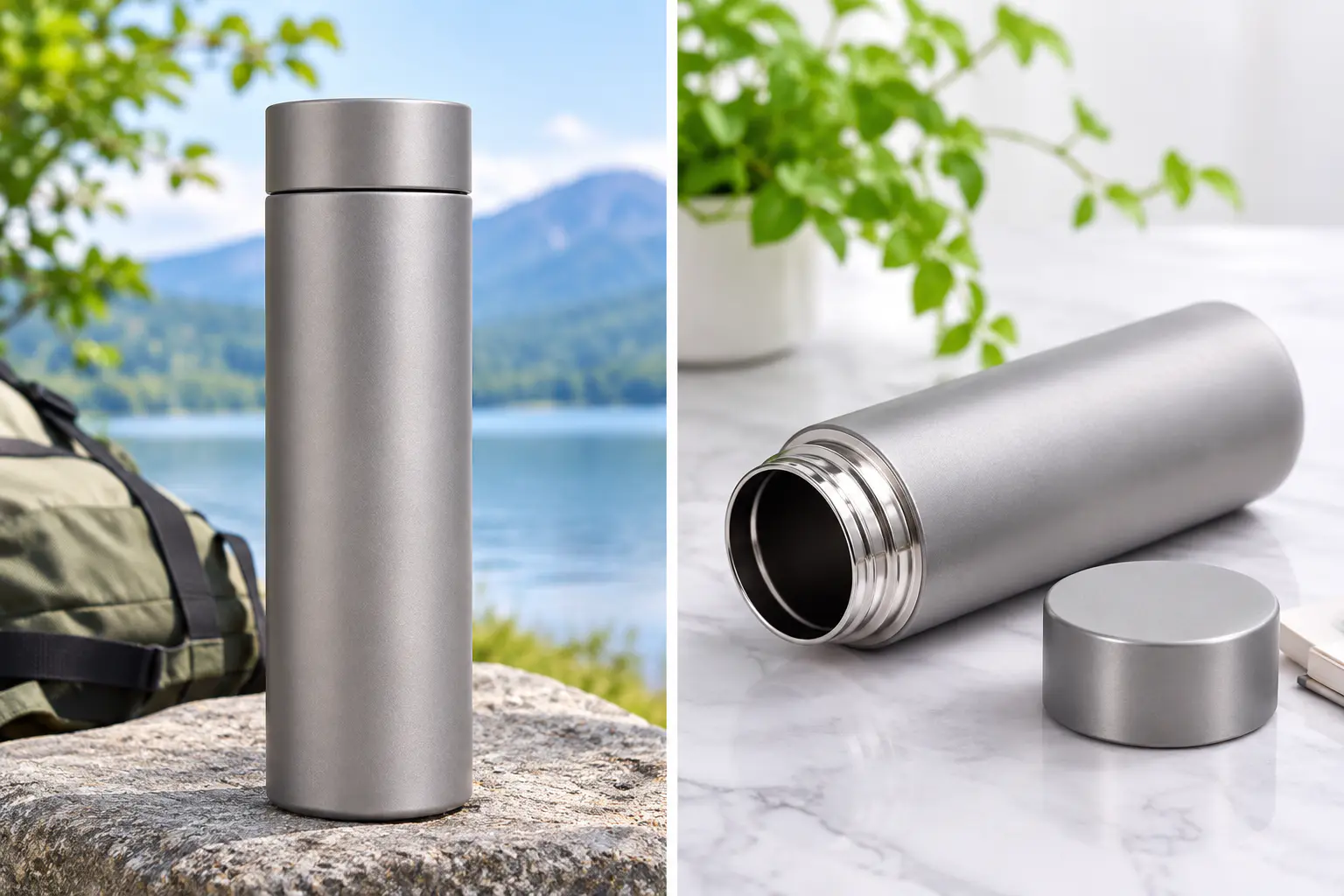
Before attempting to identify a pure titanium cup, it is essential to understand the distinctions between various titanium-based materials.
Common types of titanium cups found on the market today include:
These cups are crafted primarily from commercially pure titanium—common grades include TA1 and TA2. Their defining characteristics are their light weight, strong corrosion resistance, and chemical stability.
In a genuine pure titanium cup, the components labeled as "pure titanium" must meet the standards for that specific grade of titanium; it is not merely a matter of having titanium applied to the surface.
Titanium alloys are created by combining titanium with other elements, such as aluminum or vanadium. This process adjusts the material's composition to enhance properties like strength and hardness.
While titanium alloys are highly functional and valuable, they are distinct from commercially pure titanium. Consumers should be careful to differentiate between the two when making a purchase.
Some products use stainless steel as a base material, which is then treated with a titanium plating or another type of titanium-containing coating.
These products are not "pure titanium" cups. Although their surfaces may mimic the color and texture of titanium, the underlying material remains stainless steel.
These products typically feature a stainless steel exterior combined with a titanium interior liner—a composite structure.
When purchasing, it is important to verify the specific materials used for the liner, the outer shell, and other components; do not simply assume that such a cup is made entirely of titanium (both inside and out).
Weight is one of the key material characteristics of a titanium cup.
The density of titanium is approximately 4.51 g/cm³, whereas the density of common 304 stainless steel is about 7.93 g/cm³. For a given volume, titanium is significantly lighter than 304 stainless steel.
Consequently, given the same capacity, similar dimensions, and comparable construction, a cup made entirely of titanium will generally be lighter.
This is a key reason why titanium cups are popular among outdoor enthusiasts, campers, and travelers.
However, weight should only serve as a preliminary reference rather than a definitive criterion. Factors such as wall thickness, capacity, structural design, and the material of the lid all influence the final weight.
Titanium possesses a unique metallic quality, and various surface treatment techniques can produce distinct visual effects.
Common surface treatments for titanium cups include sandblasting, polishing, brushing, and anodizing.
Sandblasting creates a refined, matte texture; polishing enhances surface luster; brushing produces a consistent, fine-textured pattern; and anodizing allows for the creation of various colors by controlling the thickness of the surface oxide layer.
These processes not only enrich the product's appearance but also cater to the diverse stylistic preferences of consumers.
It is important to note that surface color and luster are not conclusive proof that a cup is made of pure titanium. Stainless steel can also be treated with specific finishes to achieve similar visual effects.
Therefore, appearance should only be used as a supplementary indicator; confirmation should always be sought through official material documentation.
This is a crucial step in identifying whether a cup is made entirely of titanium.
When making a purchase, consumers can request material specifications and relevant test reports from the seller.
Start by checking the material grade specified for the product. Verify the specific grade of titanium used in the product—such as TA1 or TA2—and cross-reference it with the corresponding material standards.
Additionally, examine the raw material certificates and material test reports. You can consult reports issued by third-party testing laboratories to determine the composition of titanium and other elements, ensuring the material meets the requirements for the specified grade.
Furthermore, it is essential to understand the product's specific construction. If you are purchasing a double-walled insulated cup, confirm the materials used for individual components, such as the inner liner, outer shell, and base.
For products labeled as "pure titanium" (both inside and out), verify that both the inner and outer surfaces are indeed made of compliant pure titanium, rather than having only the inner liner made of titanium.
For a more precise assessment of the material used in a titanium cup, you can employ professional analytical equipment.
XRF analysis identifies the elemental composition of metallic materials, helping to determine whether a product contains titanium and whether any other alloying elements are present.
This method is relatively fast, making it suitable for preliminary material screening.
However, since XRF primarily analyzes the surface layer, it may not definitively confirm that the underlying substrate is also pure titanium—especially if the product features a thin coating.
ICP analysis provides a highly accurate breakdown of elemental content, which is useful when a more rigorous verification of material composition is required.
This process typically involves taking a sample and having it analyzed in a professional laboratory.
Once testing is complete, compare the elemental content against the relevant titanium standards to confirm whether the material meets the requirements for specific grades like TA1 or TA2.
For brands and importers with stringent procurement requirements, it is advisable to establish a formal material inspection protocol for both raw material sourcing and finished product acceptance.
Beyond verifying that the material is pure titanium, you should also pay attention to the product's manufacturing quality.
The production of titanium cups involves several stages, including forming, welding, and finishing. Welded joints should be smooth and secure, with no visible cracks, incomplete fusion, or other defects.
The rim of the cup should be smooth and even, while the interior walls should be free of noticeable burrs, scratches, or manufacturing residues. A high-quality surface finish enhances the overall user experience.
For titanium cups with lids, examine how well the lid fits the cup body, as well as the installation and effectiveness of the sealing ring. A well-designed sealing structure reduces the risk of leaks during daily carry.
If you are purchasing a double-walled vacuum-insulated titanium cup, evaluate its vacuum structure, thermal insulation test data, and real-world performance.
The use of pure titanium alone does not guarantee good thermal insulation; the actual performance depends primarily on the product's structural design and manufacturing process.
Thanks to their lightweight nature, strong corrosion resistance, and chemical stability, pure titanium cups have increasingly become a preferred choice in the high-end drinkware market.
However, when making a purchase, one should not rely solely on appearance, weight, or marketing claims to determine whether a product is truly made of pure titanium.
A more reliable approach involves considering factors such as the material grade, material certification, product structure, and results from professional testing.
For consumers, understanding the differences between various titanium products helps in selecting items that better meet their specific needs. For brands and purchasers, maintaining strict control over raw material quality, production processes, and finished-product testing is essential to ensuring the quality of titanium cups.
As consumer expectations regarding material composition and product quality continue to rise, titanium cups from manufacturers that prioritize material transparency, refined production processes, and rigorous quality management are more likely to gain market recognition.
Your email address will not be published. Required fields are marked *
* Your email is safe with us, we don't spam.

Our company's products include vacuum flasks, beer mugs, coffee mugs, car tumbler, fire stove and tensile parts, etc.
Phone: +86-13566758039
Tel: +86-0579-87171178
Fax: +86-0579-87171178
E-mail: [email protected]
Add: No.29, Qiaodong Road, Qiaotouzhou Village, Longshan Town, Yongkang, Jinhua, Zhejiang, China.
Copyright © 2026 Yongkang Aijun Industry & Trade Co., Ltd.


 English
 中文简体
 日本語
 Français
 Español