+86-13566758039


A bottle that is opened for drinking and closed for mixing has several use states. The customer needs to understand which part closes the drinking opening, how the main lid fits and what the product is intended to contain. A useful review follows that sequence rather than treating the bottle as a container with one simple leak-proof claim.
Consider the 750ml shakeable vacuum thermos. The direct-drink closure and removable main lid give the product several distinct use states. Those states provide a practical structure for sample evaluation and customer instructions.
The Aijun product reference is a 750ml shakeable vacuum thermos with a direct-drink lid arrangement. Confirm the usable fill guidance and the supplied mixing component with the manufacturer. Nominal capacity does not necessarily describe the recommended fill level for every mixing operation.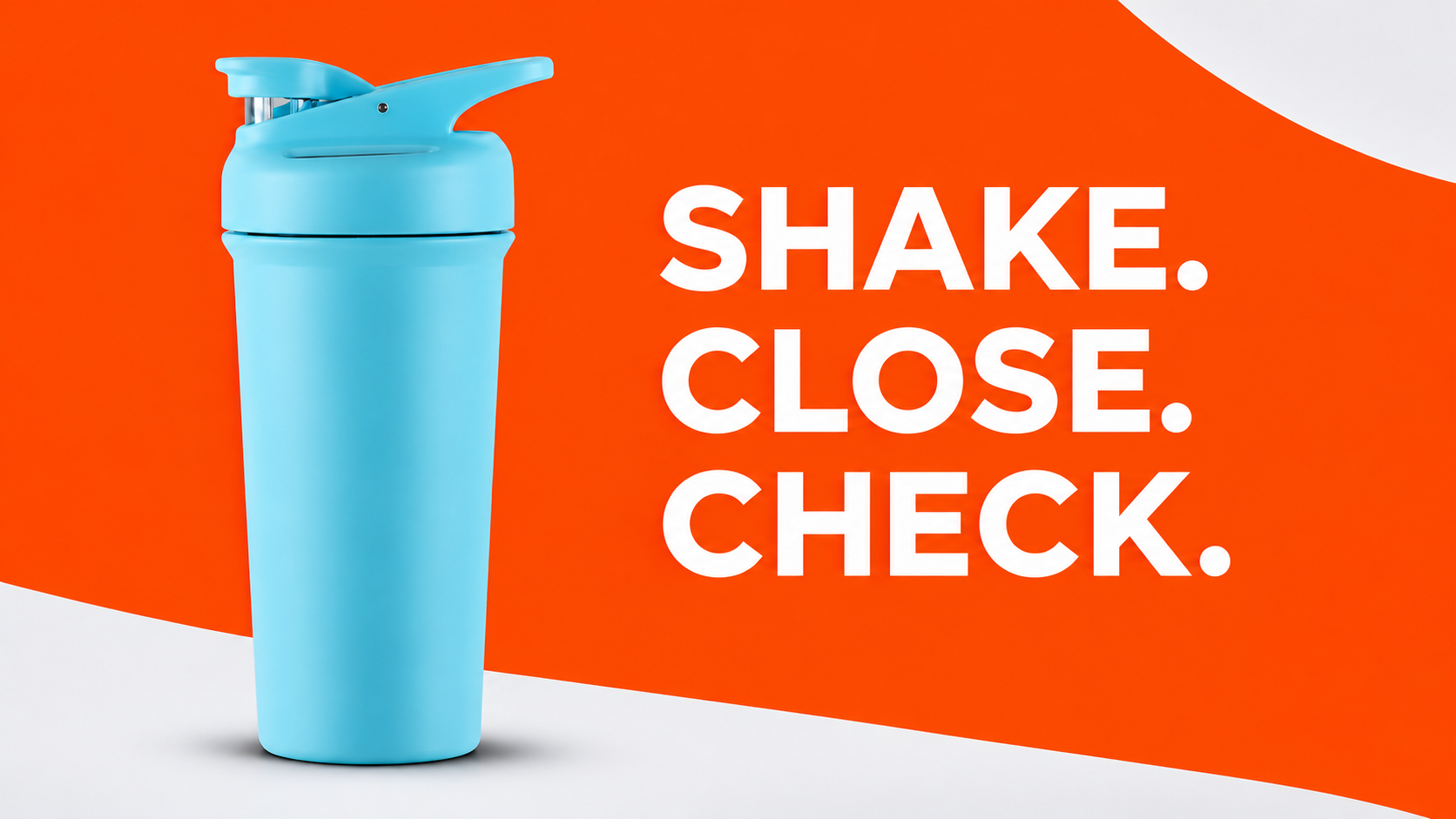
Check how the lid is removed and refitted, and whether the user can see that the sealing area is clean. Powder or residue around a sealing interface can create a different condition from a clean-water sample. The instructions should explain the intended filling method without promising that the bottle works with every beverage.
Ask the supplier which liquids and temperatures are permitted for shaking. A product described as insulated or suitable for hot drinks should not automatically be promoted for shaking hot liquids. Obtain the specific use guidance and make the distinction clear in customer-facing instructions.
Review the closure sequence before any agreed evaluation. The main lid and drinking opening may require separate actions. A sample record should identify which parts were closed, what liquid and fill level were used and how the result was assessed. Avoid turning an undefined demonstration into a universal leak-proof guarantee.
The main lid-to-body joint and the drinking closure do different jobs. During sample review, identify which joint is opened for filling and which opening is used for drinking. Check that instructions do not use the same vague word, such as cap, for both parts where that could confuse the customer. A simple component illustration can help if it is based on the supplied lid.
The selected cyan product has a distinctive projecting drinking mechanism. Keep its real shape in photographs and avoid replacing it with a generic sports-bottle lid in promotional images. The visual sequence should match what the customer handles. When an OEM color or decoration changes, confirm that the mechanism itself remains the same before reusing an instruction diagram. That check connects useful marketing content to the actual assembled product.
The visible lid includes a drinking closure and a projecting opening mechanism. Review operation with the real sample rather than assuming that the appearance communicates every action. Check whether the closure stays clear of the drinking position and whether its intended open and closed states are obvious.
If the brand wants one-handed-use wording, evaluate that specific claim with the intended product and instructions. Ease of operation can vary with grip, hand size and conditions. Describe the mechanism accurately instead of presenting one person’s demonstration as a result for every customer.
| Review item | Evidence to retain | Decision supported |
|---|---|---|
| Filling | Approved fill and liquid guidance | Correct use |
| Mixing | Defined closure and evaluation conditions | Supported statement |
| Drinking | Actual lid operation | Clear instructions |
| Cleaning | Component-specific care guide | Repeatable maintenance |
The bottle body, lid and any mixing accessory may have different care requirements. Confirm what can be removed for cleaning and how the pieces are reassembled. Do not invent dishwasher suitability or instruct the user to pry out a seal unless the manufacturer explicitly allows that action.
Review areas where powder or beverage residue can remain, particularly around closures and internal accessories. Care information should identify the permitted cleaning method and complete drying before storage. It should not claim that the bottle sterilizes itself or prevents all odor.
Assess the product with its intended components installed. A bottle shown without an accessory may fit a carton differently from the supplied set. The retail component list, photographs and assembly instructions should agree.
If the body is printed or coated for an OEM order, review the actual decorated sample and care wording. A finish may need its own handling instructions. The attractive blue body in the product photograph is a visual reference, not evidence for every proposed decoration process or durability claim.
Keep intended uses, closure actions and limitations close together in the instruction insert. A customer should not have to reconcile a broad marketing headline with a restrictive note hidden elsewhere. Make filling, closing and drinking steps easy to distinguish.
Any thermal-retention claim needs a defined test basis for the exact configuration. This use-mode review does not reproduce retention-hour numbers because those figures do not describe every beverage, fill condition or opening frequency. Agree the evidence and wording separately if that claim is important to the range.
Ask Aijun to confirm the intended liquids, fill guidance, lid operation and cleaning method with the final sample. Keep the accepted use instructions connected to the exact lid and body configuration.
The result is a more useful product story: a bottle that can be understood through its real use states. That gives the brand practical content while keeping broad performance claims tied to evidence rather than the product name alone.
Your email address will not be published. Required fields are marked *
* Your email is safe with us, we don't spam.

Our company's products include vacuum flasks, beer mugs, coffee mugs, car tumbler, fire stove and tensile parts, etc.
Phone: +86-13566758039
Tel: +86-0579-87171178
Fax: +86-0579-87171178
E-mail: [email protected]
Add: No.29, Qiaodong Road, Qiaotouzhou Village, Longshan Town, Yongkang, Jinhua, Zhejiang, China.
Copyright © 2026 Yongkang Aijun Industry & Trade Co., Ltd.


 English
 中文简体
 日本語
 Français
 Español